
OpenFOAM 14 vs v2606 for Marine CFD
This OpenFOAM 14 vs v2606 comparison focuses on a distinction that every Marine CFD user should understand before following tutorials, selecting solvers, or using official documentation. OpenFOAM 14 and OpenFOAM v2606 share a common historical origin, but they are not consecutive releases of a single software line. They belong to independently developed OpenFOAM distributions with different release numbering, documentation ecosystems, solver organization, and software workflows.
This distinction becomes especially important in Marine CFD, where simulations quickly extend beyond simple incompressible flow into free-surface modelling, mesh motion, rotating machinery, 6DoF motion, and Overset Mesh.
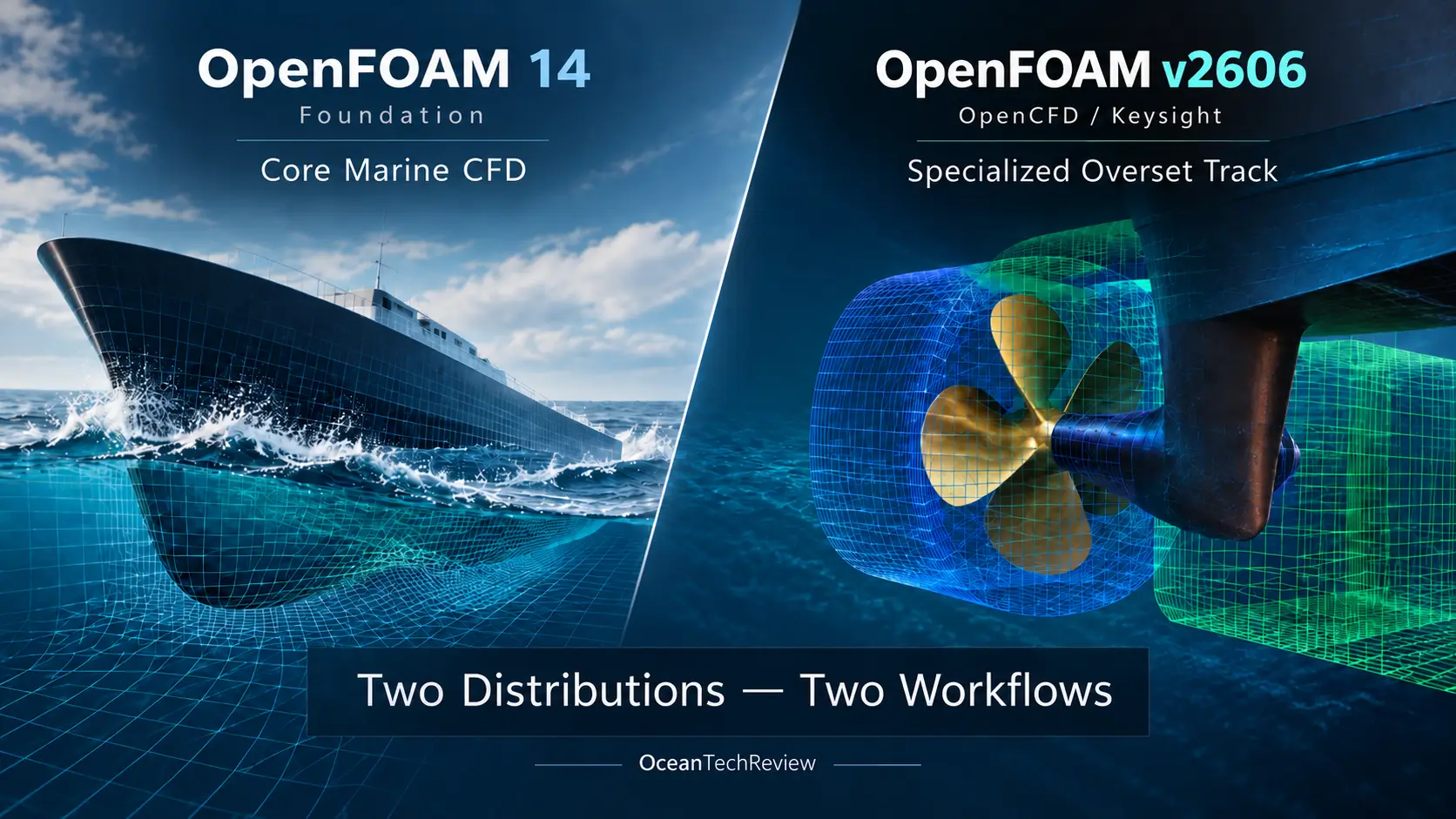
For the OceanTechReview Marine CFD series, the separation will therefore remain explicit: OpenFOAM 14 Foundation is used for the core Marine CFD path, while OpenFOAM v2606 OpenCFD / Keysight is used for the specialized Overset track.
1. OpenFOAM 14 and v2606: Two Distributions
The OpenFOAM 14 vs v2606 distinction is one of the first things users should understand when working across modern OpenFOAM tutorials, official documentation, source repositories, and Marine CFD workflows. These resources commonly use two very different types of version names: OpenFOAM 14 and OpenFOAM v2606.
At first glance, it is easy to assume that v2606 is simply a later release than OpenFOAM 14. That interpretation is misleading because the two names belong to separate development lines.
OpenFOAM 14 belongs to the OpenFOAM Foundation release line, while v2606 belongs to the OpenCFD release ecosystem. Both retain a substantial amount of common CFD heritage, but their software development has evolved independently.
This article is not a ranking of the two distributions. The purpose is to define which software ecosystem is being used at each stage of the OceanTechReview Marine CFD workflow and to prevent commands, solver names, or documentation from different distributions being mixed unintentionally.
2. Two Independent Release Numbering Systems
In any OpenFOAM 14 vs v2606 comparison, release numbering is the most visible indication that the two software environments belong to independent development lines.
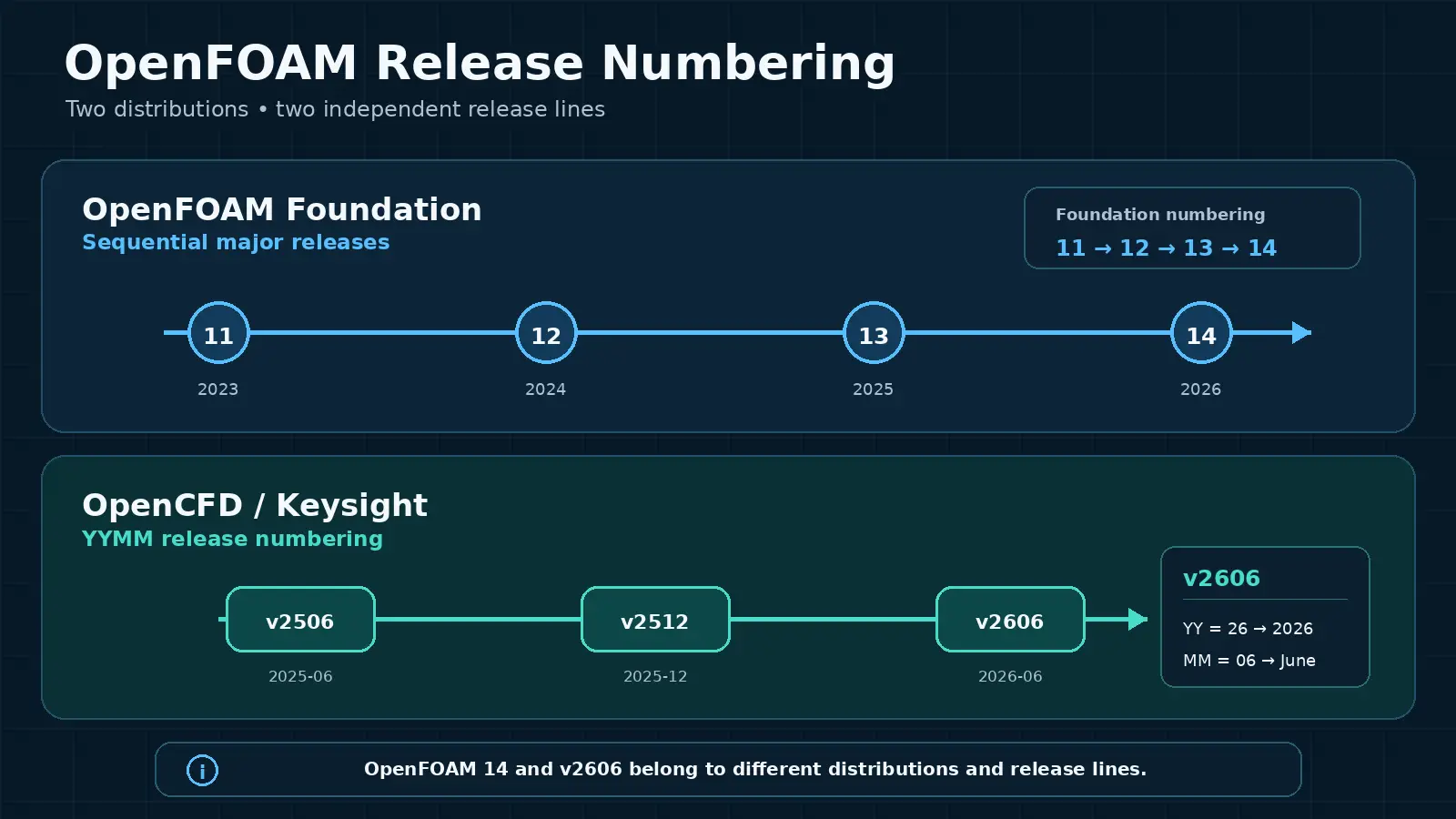
The OpenFOAM Foundation uses sequential major version numbers. Recent releases therefore follow a sequence such as 11 → 12 → 13 → 14. The number itself identifies the major release and does not encode the year or month.
OpenCFD uses date-based release identifiers. In that system,
v2506 corresponds to June 2025,
v2512 to December 2025, and
v2606 to June 2026. The official
OpenCFD release history
shows these releases as a separate chronological line.
| Characteristic | OpenFOAM 14 | OpenFOAM v2606 |
|---|---|---|
| Distribution | OpenFOAM Foundation | OpenCFD / Keysight |
| Release naming | Sequential major version | YYMM date-based release |
| Example sequence | 12 → 13 → 14 | v2506 → v2512 → v2606 |
| Primary documentation path | Foundation / CFD Direct | OpenFOAM.com / OpenCFD |
| Role in this series | Core Marine CFD | Specialized Overset CFD |
This difference may appear minor, but identifying the correct release line is the first step toward finding the correct documentation, solver architecture, and configuration reference.
3. OpenFOAM 14: The Foundation Track
OpenFOAM 14 is the software environment used for the main OceanTechReview Marine CFD learning path.
The
OpenFOAM v14 User Guide
describes the modern Foundation workflow in which
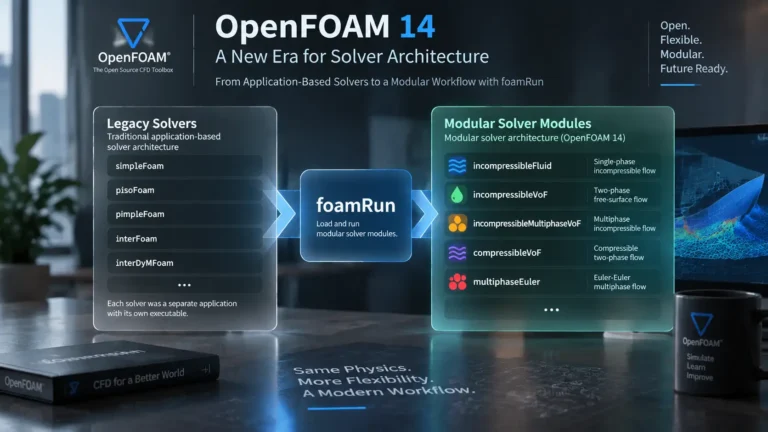
foamRun can load solver modules that define the physical
problem being solved.
Modular Solver Architecture
Long-time OpenFOAM users may be familiar with dedicated application
names such as simpleFoam, pimpleFoam, and
interFoam. Modern Foundation releases increasingly
organize flow solutions around solver modules rather than requiring a
separate executable for every problem family.
Two modules are especially relevant to the later Marine CFD path:
incompressibleFluid for incompressible single-phase
flows and incompressibleVoF for two incompressible,
immiscible fluids using a Volume of Fluid formulation.
At this stage, the important point is the architecture—not the detailed syntax or execution procedure. Solver configuration and migration from older solver names are treated separately later in the series.
4. OpenFOAM v2606: The OpenCFD / Keysight Track
OpenFOAM v2606 belongs to the OpenCFD release ecosystem. The official current-release page identifies v2606 as the June 2026 release.
The governing CFD concepts remain familiar: finite-volume discretization, incompressible flow, turbulence modelling, Volume of Fluid methods, mesh motion, and many utilities share common historical foundations with the Foundation distribution.
The software organization, however, is not identical. The v2606
ecosystem retains a wide range of solver applications such as
simpleFoam, pimpleFoam, and
interFoam, alongside applications designed for specialized
workflows.
This is one reason OpenFOAM tutorials found online may appear to
contradict one another. A tutorial based on foamRun and
another built around a named solver application may simply belong to
different OpenFOAM distributions.
OceanTechReview uses v2606 specifically for the specialized Overset track. This is an editorial and workflow decision for this series, not a universal claim that one OpenFOAM distribution is superior to the other.
5. Different Solver Ecosystems
The OpenFOAM 14 vs v2606 solver comparison makes the architectural differences between the two distributions especially clear.
In the Foundation 14 track, foamRun provides a general
execution framework for solver modules such as
incompressibleFluid and
incompressibleVoF.
In v2606, users encounter an application-oriented ecosystem containing
familiar solver names and specialized Overset applications including
overSimpleFoam, overPimpleDyMFoam, and
overInterDyMFoam.
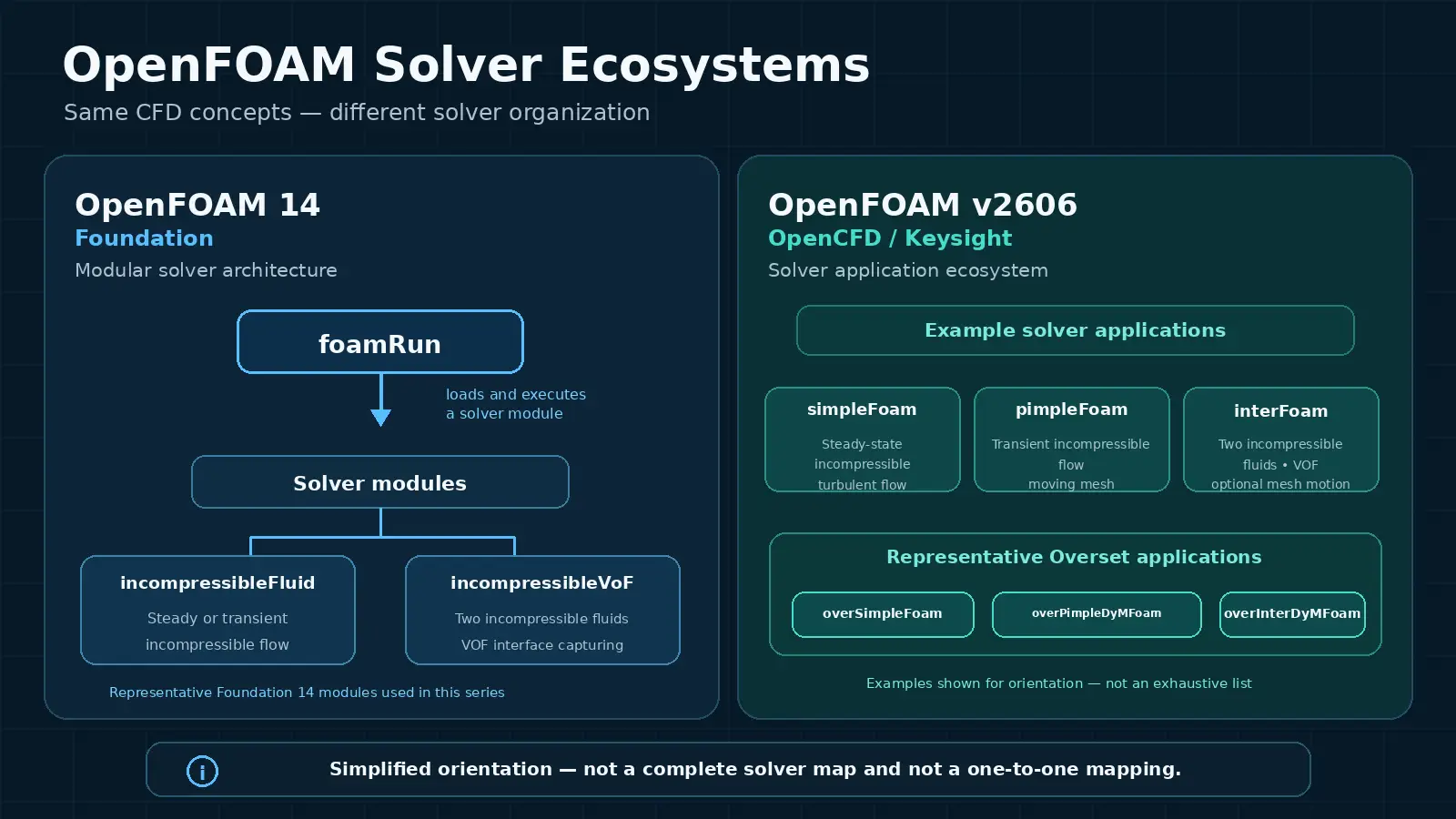
A direct one-to-one mapping should not be inferred from the figure. Solver history, changes in architecture, and the relationship between older application names and modern Foundation modules require a separate discussion.
6. Documentation Must Match the Distribution
Documentation is one of the most important practical differences in an OpenFOAM 14 vs v2606 workflow. It is not interchangeable between the two software ecosystems.
For Foundation 14, the primary references include the OpenFOAM 14 Foundation release resources, the OpenFOAM v14 User Guide, and the OpenFOAM v14 C++ Source Code Guide.
For the v2606 ecosystem, users should refer to the OpenFOAM v2606 documentation and the v2606 API documentation.
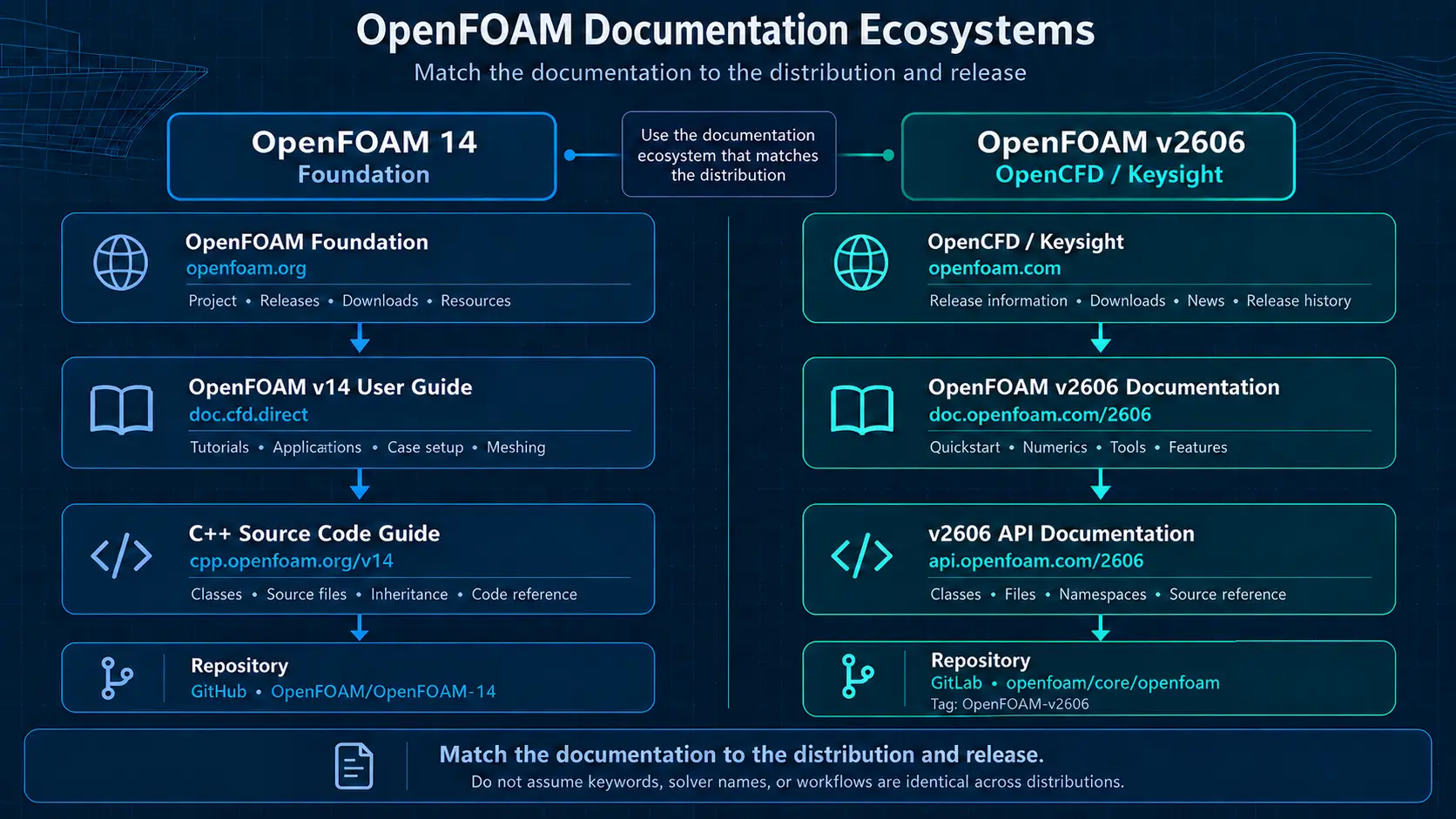
A keyword, library, model, boundary condition, solver name, or mesh-motion setting documented for one distribution may not exist in exactly the same form in the other. Sometimes the same physical concept is implemented differently; sometimes the syntax or application name changes.
Practical rule: before copying configuration from an online tutorial, verify its OpenFOAM distribution, release number, documentation source, and solver architecture.
7. Why OpenFOAM 14 vs v2606 Matters in Marine CFD
For Marine CFD, the OpenFOAM 14 vs v2606 distinction becomes more important as the physical and numerical complexity of a simulation increases.
A simple incompressible case may not expose many differences. Marine CFD, however, quickly involves free surfaces, dynamic meshes, rotating components, moving bodies, wave modelling, and coupled rigid-body motion.
Consider 6DoF motion. Mass, inertia, force, moment, translation, and rotation are physical concepts that do not depend on a particular OpenFOAM distribution. Their connection to solver architecture, mesh motion, libraries, dictionaries, and runtime configuration does.
The same principle applies to free-surface CFD. VOF is transferable numerical knowledge, while the exact solver or module selection and software implementation must be checked against the distribution being used.
Learn the CFD physics broadly. Follow the software implementation precisely.
Readers working more broadly on numerical uncertainty, wall resolution, time-step control, and validation can also use the OceanTechReview Hydrodynamics, CFD & Experimental Methods resources.
8. The OceanTechReview Marine CFD Roadmap
The OceanTechReview OpenFOAM 14 vs v2606 roadmap is designed to keep transferable CFD principles connected while separating distribution-specific implementation. The Marine CFD learning path is therefore organized around two related but clearly separated software tracks.
The main path uses OpenFOAM 14 Foundation to develop the core CFD workflow from fundamentals through meshing, numerical methods, free-surface flow, offshore applications, and ship hydrodynamics.
The second path uses OpenFOAM v2606 for the specialized Overset workflow involving overlapping meshes, large relative motion, marine propellers, free-surface Overset CFD, and 6DoF applications.
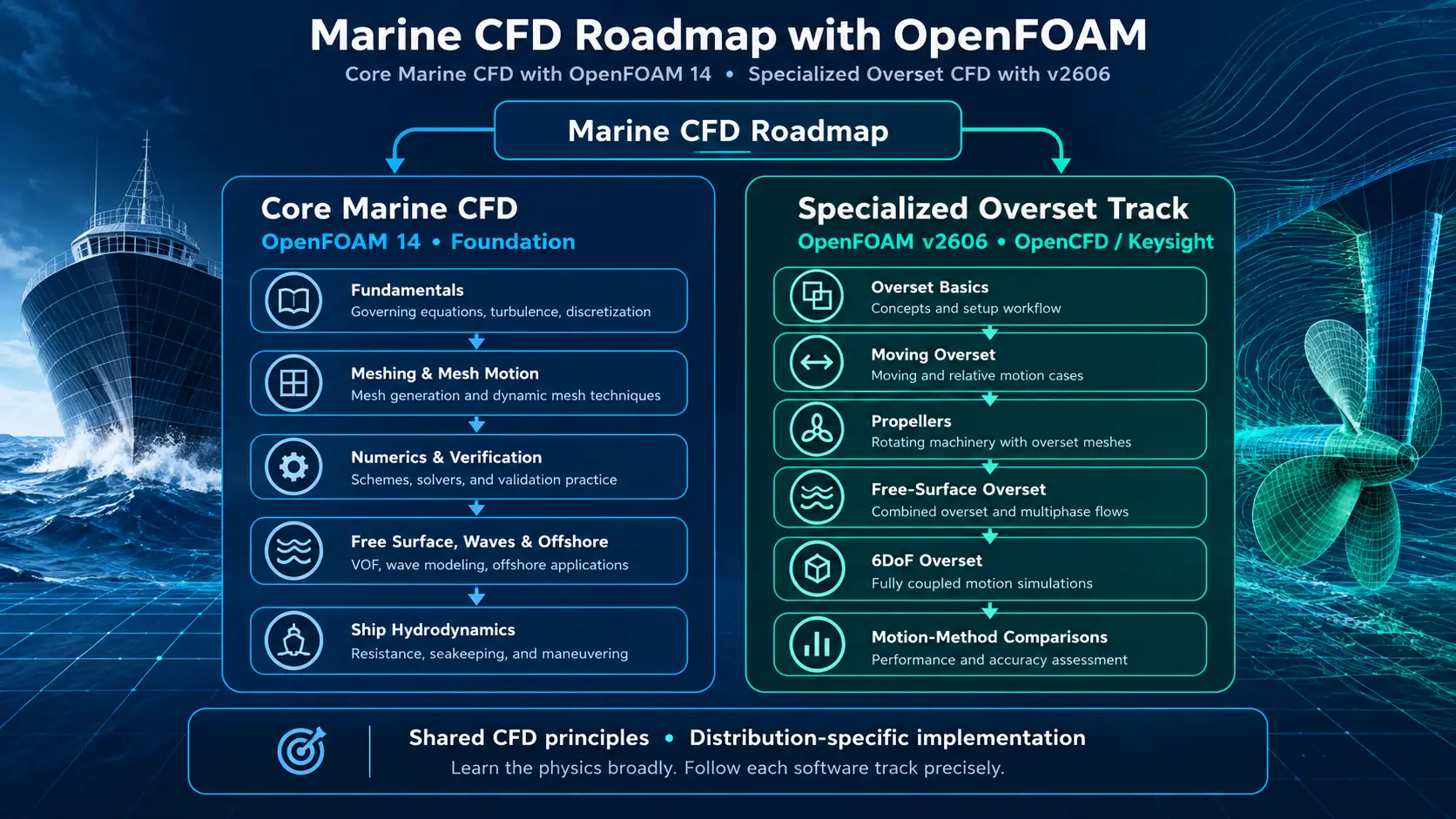
Fundamentals, meshing, mesh motion, numerical methods, verification, free-surface CFD, waves, offshore hydrodynamics, and ship hydrodynamics.
Overset fundamentals, moving Overset meshes, rotating propellers, free-surface Overset, 6DoF motion, and motion-method comparisons.
The wider OceanTechReview Research Reviews section provides additional engineering context across ship hydrodynamics, naval architecture, marine systems, and emerging ocean technologies.
9. What Transfers Between the Two Distributions?
The most useful way to interpret OpenFOAM 14 vs v2606 is to separate transferable CFD knowledge from distribution-specific software implementation. A large part of CFD knowledge transfers directly between OpenFOAM 14 and v2606. The governing equations and physical interpretation of a simulation do not change merely because the software distribution changes.
Finite-volume concepts, Navier–Stokes equations, Reynolds number, Courant number, turbulence modelling, VOF, mesh quality, hydrodynamic forces, rigid-body dynamics, verification, and validation.
Solver names, modules, applications, dictionary keywords, libraries, boundary-condition implementations, mesh-motion configuration, execution commands, and feature-specific syntax.
How to Identify the Distribution Used by a Tutorial
Three clues are particularly useful. First, inspect the version number:
a release written as 14 follows the Foundation numbering
convention, while v2606 follows the OpenCFD date-based
convention.
Second, inspect the documentation source. Foundation and CFD Direct references indicate the Foundation ecosystem, while OpenFOAM.com, doc.openfoam.com, and api.openfoam.com identify the OpenCFD documentation line.
Third, inspect the solver organization. A workflow based on
foamRun with modules such as
incompressibleFluid indicates modern Foundation
architecture, while workflows centred on application names such as
simpleFoam, pimpleFoam,
interFoam, or dedicated over...
applications point toward the other ecosystem.
No single clue needs to be treated as absolute proof because the two distributions retain considerable historical overlap. Taken together, however, version naming, documentation origin, and solver organization usually make the software environment clear.
10. Conclusion: One CFD Foundation, Two Software Ecosystems
The OpenFOAM 14 vs v2606 comparison ultimately comes down to understanding the difference between shared CFD principles and distribution-specific implementation. OpenFOAM 14 and OpenFOAM v2606 share important CFD concepts and a common historical origin, but they should not be treated as two consecutive releases of one software distribution.
Their release numbering, documentation ecosystems, solver organization, repositories, and implementation details follow different development paths.
In the OceanTechReview Marine CFD series, OpenFOAM 14 Foundation provides the consistent software environment for the core learning path, including meshing, numerical methods, mesh motion, free-surface CFD, waves, offshore applications, and ship hydrodynamics.
OpenFOAM v2606 OpenCFD / Keysight is reserved for the specialized Overset track, where that software ecosystem will be introduced explicitly rather than mixed into Foundation-based cases.
The key distinction is therefore between two layers: transferable CFD physics and distribution-specific software implementation. Keeping those layers separate creates a much clearer foundation for the rest of the series.